

Deliverytime after 15-05-2026
Model:
Blade steel:
Hardness:
Steel specification:
Blade Thickness:
Blade Length:
Total Length:
Handle material:
Sheath:
Remarks:
Price incl. 21 % VAT:
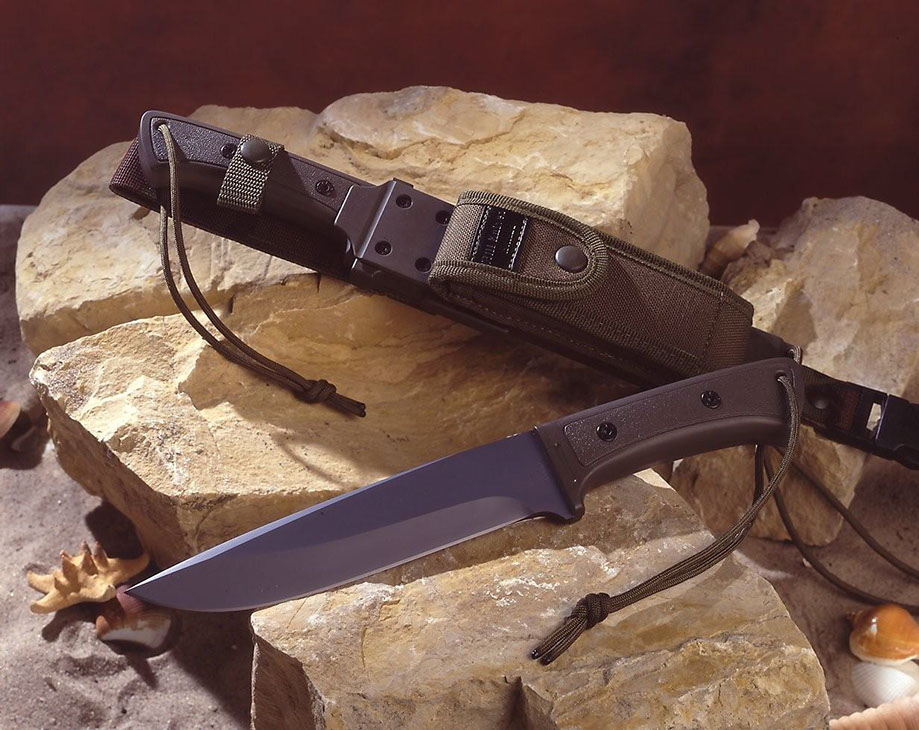
SOK (Special Operation Knife)
N690 Co Din 1.4528
59 Rockwell Vacuum hardened
CSiMnCrMoVCo
1,070,400,4017,301,100,101,50
5,0 MM
190 MM
320 MM
Green Polycarbonate
Green Polycarbonate
Titanium coated blade. The blade is left,
right and upside down portable
€ 435,-
ROTTERDAMS VAKWERK BIJ DE COMMANDO’S
DE SPECIAL OPERATIONS KNIFE (SOK) VAN HILL KNIVES
We leven in een tijd van ongekende innovatie. Of het nu gaat om Artificial Intelligence, satelliettechnologie of toegepaste kwantumfysica. Het lijkt wel alsof moderne techniek heden en toekomst bepaalt. Toch zijn er ook dingen die al eeuwen hetzelfde zijn. Naast hun GPS, hun verbindingsapparatuur, hun drones en hun nachtkijkers dragen de meeste militairen op het slagveld namelijk nog steeds een mes.
Een Special Operations Knife (SOK). Bron: Hill Knives Holland
SURVIVAL
Dat kan een bajonet zijn – en uiteindelijk is dat ook gewoon een mes dat je op je geweer kunt klikken – maar veel operators, vooral in speciale eenheden, dragen gespecialiseerde blanke wapens. Dat kunnen messen zijn voor ‘sociale contacten’ zoals militairen dat zelf zo mooi eufemistisch kunnen zeggen, of voor andere taken. Zo hadden de mannen van het Korps Commando Troepen (KCT) halverwege de jaren ’90 van de vorige eeuw behoefte aan een survival-mes.
OVERLEVEN IN HET WILD
Een survival- of bushcraft-mes (zoals het tegenwoordig vaak heet) is een mes dat je gebruikt als je wil overleven in de wilde natuur. Als je dieren wil vangen en slachten, van het land moet leven, zelf een onderkomen moet bouwen, dat soort zaken. Het KCT wendde zich tot de firma Hill Knives in Rotterdam. Messenmakers Frans en Albert van den Heuvel – vader en zoon – ontwierpen een groot, oerdegelijk mes, dat aan alle eisen zou moeten voldoen. Ze noemden het wapen de Special Operations Knife (SOK). Twee prototypes werden geleverd om getest te worden.
TORTURE TESTING
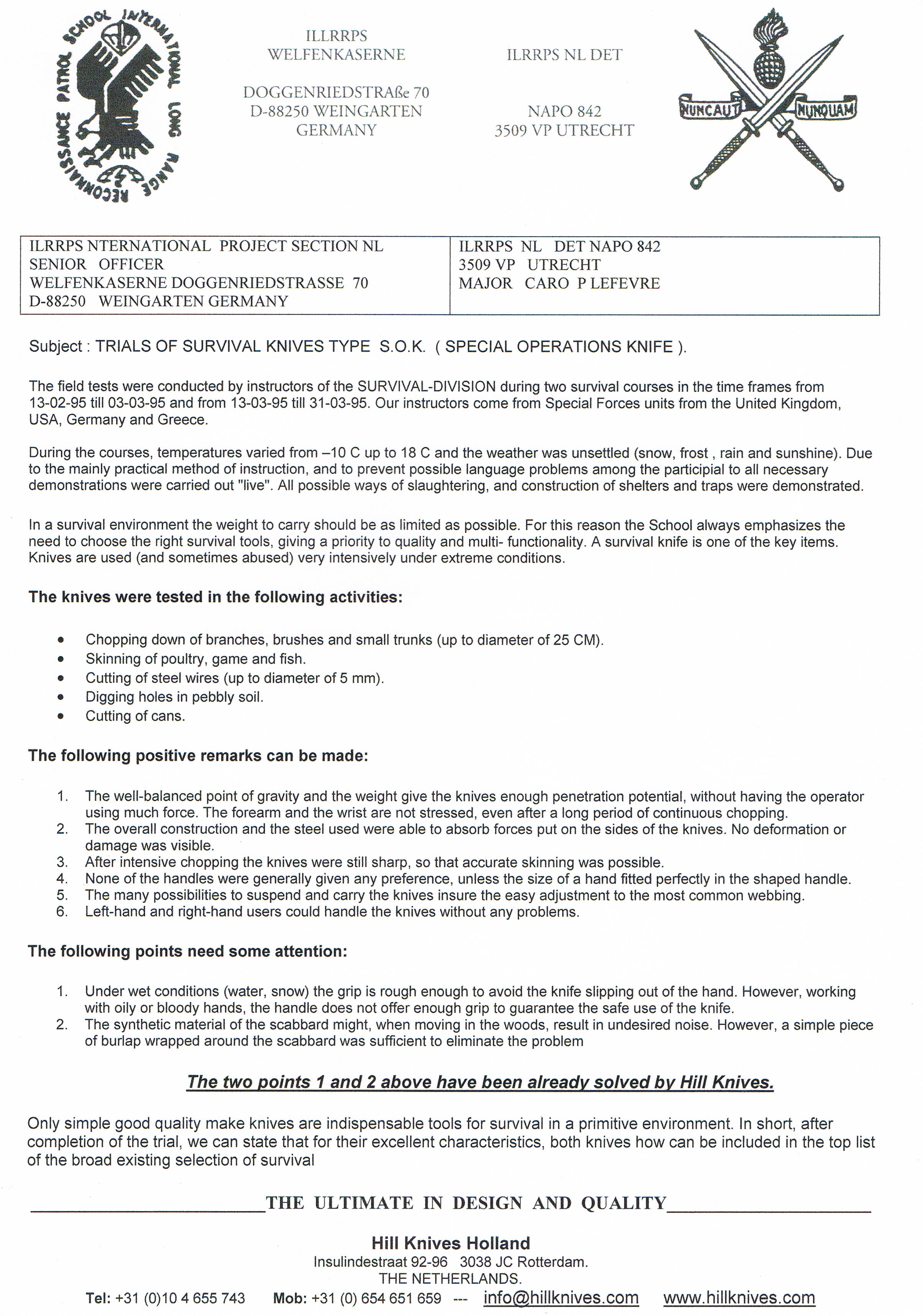
In maart 1995 werden de messen onder extreme omstandigheden uitgeprobeerd door het KCT. Zo werden er takken, struiken en stammen tot een diameter van 25 cm gekapt. Werd er pluimvee, wild en vis mee geslacht, werd er staaldraad tot 5 mm mee gesneden, groef men gaten in steenachtige grond en werden er blikken mee geopend.
Het oorspronkelijke testrapport vermeldde onder meer dat ‘gewicht en balans zodanig zijn dat onderarm en pols niet vermoeid raken, ook niet na een uur ononderbroken kappen’. De messen hadden na afloop van de test geen waarneembare beschadigingen of vervormingen; ook na zwaar kapwerk was het mes nog steeds scherp genoeg om nauwkeurig mee te kunnen villen. Zowel links- als rechtshandige commando’s konden goed met het mes overweg. Mij is verteld dat ze één van de messen ook hebben gebruikt als opstap bij een rotsklim. Dat betekent dat tientallen mannen met bepakking het in een rotsspleet gestoken mes als traptrede hebben benut. De SOK gaf geen krimp.
De Special Operations Knife uit onze collectie.
MET VLAG EN WIMPEL
Er waren maar twee kleine minpuntjes: hoewel het mes bij regen en sneeuw niet uit de hand glipte, gebeurde dat met bebloede handen af en toe wel. Daarnaast maakte de kunststof schede soms wat lawaai bij ‘verplaatsingen in het terrein’.
KWALITATIEF SUPERIEUR
Beide minimale euvels werden door vader en zoon snel verholpen, en vanaf 1998 werden ongeveer 350 Special Operations messen ingevoerd bij de krijgsmacht. En daar worden ze nog steeds naar volle tevredenheid gebruikt. Dat het mes kwalitatief superieur is blijkt uit het feit dat twee jaar geleden – dus meer dan 20 jaar na invoering! – pas een eerste partij van 110 stuks retour kwam om gerepareerd en geslepen te worden. Ik durf de stelling wel aan dat de Special Operations Knife het beste militaire survivalmes van de wereld is. Geen woorden maar daden!
TE ZIEN IN HET MUSEUM
Bekijk het KCT-survivalmes in de vaste opstelling van het Nationaal Militair Museum, in het kabinet met moderne bewapening op de begane grond.
"De Special Operations Knife is het beste militaire survivalmes van de wereld."Dirk Staat - Conservator
ROTTERDAM'S CRAFTSMANSHIP AT THE COMMANDO'S
THE SPECIAL OPERATIONS KNIFE (SOK) FROM HILL KNIVES
We live in a time of unprecedented innovation. Whether it's Artificial Intelligence, satellite technology, or applied quantum physics, it seems as if modern technology defines the present and the future. Yet, there are also things that have remained the same for centuries. Besides their GPS, their communication equipment, their drones, and their night vision goggles, most soldiers on the battlefield still carry a knife.
A Special Operations Knife (SOK). Source: Hill Knives Holland
SURVIVAL
That might be a bayonet—and ultimately, it's just a knife you can clip onto your rifle—but many operators, especially in special forces, carry specialized bladed weapons. These might be knives for "social contact," as soldiers themselves so euphemistically put it, or for other tasks. In the mid-1990s, the men of the Commando Corps (KCT) needed a survival knife.
SURVIVING IN THE WILD
A survival or bushcraft knife (as it's often called these days) is a knife you use to survive in the wild. Whether you want to catch and slaughter animals, live off the land, build your own shelter, or something like that. The KCT turned to Hill Knives in Rotterdam. Knifemakers Frans and Albert van den Heuvel—father and son—designed a large, rugged knife that would meet all requirements. They called the weapon the Special Operations Knife (SOK). Two prototypes were delivered for testing.
TORTURE TESTING
In March 1995, the KCT tested the knives under extreme conditions, felling branches, bushes, and trunks up to 25 cm in diameter. It was used to slaughter poultry, game, and fish, cut steel wire up to 5 mm thick, dig holes in stony ground, and open cans.
The original test report stated, among other things, that "the weight and balance are such that the forearm and wrist do not fatigue, even after an hour of continuous chopping." After the test, the knives had no noticeable damage or deformations; even after heavy chopping, the blade was still sharp enough for accurate skinning. Both left- and right-handed commandos handled the knife well. I'm told that one of the knives was also used as a step during a rock climb. This means that dozens of men with packs used the knife, inserted into a crevice, as a step. The SOK didn't flinch.
The Special Operations Knife from our collection. WITH FLAWS AND FLAGSHIP
There were only two minor drawbacks: although the knife didn't slip out of my hand in rain and snow, it did occasionally slip with bloody hands. In addition, the plastic sheath sometimes made a bit of noise when moving around in the terrain.
SUPERIOR QUALITY
Both minor issues were quickly resolved by father and son, and from 1998 onwards, approximately 350 Special Operations knives were introduced into the armed forces. And they are still used there to their complete satisfaction. The knife's superior quality is evident from the fact that only two years ago – more than 20 years after its introduction! – an initial batch of 110 was returned for repair and sharpening. I dare say that the Special Operations Knife is the best military survival knife in the world. Actions speak louder than words! ON DISPLAY AT THE MUSEUM
See the KCT survival knife in the permanent display of the National Military Museum, in the modern weaponry cabinet on the ground floor.
"The Special Operations Knife is the best military survival knife in the world." Dirk Staat - Curator
https://www.nmm.nl/nl/stories/survivalmes